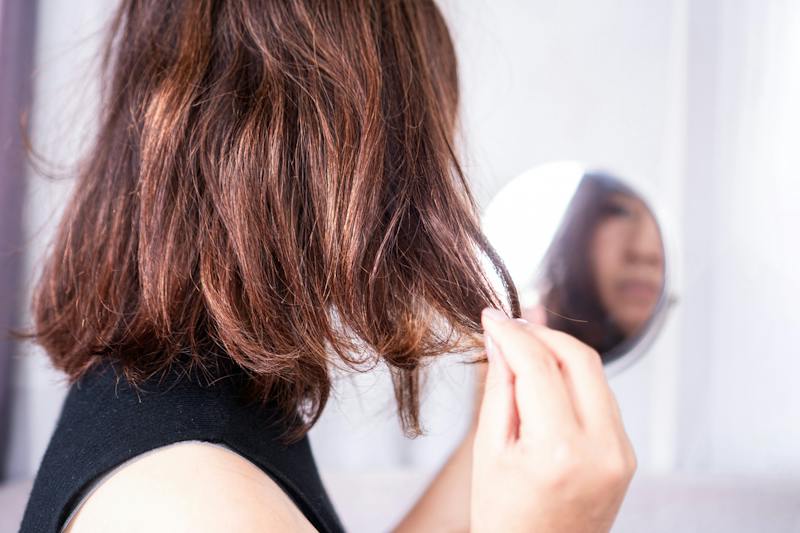
Hair breakage is when your hair strands become weak and snap or break off along the shaft, leaving you with short, frayed pieces, split ends, and extra frizz.
It is completely different from normal “hair shedding”, where the entire hair strand falls out naturally right from the root, and “hair thinning”, where the follicle thins, causing a loss of hair volume.
Think of your hair strand like a rope: shedding is when the whole rope detaches from the ceiling; breakage is when the rope gets frayed in the middle and snaps in half.
Key Differences
| Feature |
Hair Shedding |
Hair Thinning |
Hair Breakage |
| Origin |
Released from the root/follicle |
Progressive reduction in follicle density |
Snapping mid-shaft along the length |
| Visual End |
Tiny white or translucent bulb at the tip |
Widening part lines or visible scalp |
Blunt, frayed, or jagged end with no bulb |
| Strand Length |
Full length of your normal hair |
Varies (miniaturized short/thin hairs) |
Short, uneven, broken pieces |
Detailed Breakdown
- Hair Shedding: This is a natural part of the growth cycle, where 50 to 150 hairs fall out daily. A shed hair is full-length and features a small, rounded, whitish root bulb at the tip where it detached from the scalp. Excessive shedding (like telogen effluvium) leads to temporary overall volume reduction without localized frayed snapping.
- Hair Thinning: This describes a decrease in overall hair density or a widening part line rather than individual strands falling out. It occurs when hair follicles undergo miniaturization, producing finer, weaker strands over time.
- Hair Breakage: This happens when the physical hair shaft becomes brittle and snaps. It is caused by heat styling, chemical damage, or dryness. The resulting loose pieces are short, ragged, and lack any root bulb.
Why Does Hair Break?
Each hair strand is protected by an outer layer of overlapping scales called the cuticle. When your hair is healthy, these scales lie flat to hold the moisture inside. When the cuticle gets damaged, the scales lift and fall apart, leaving the inner core of your hair dry, brittle, and exposed.
The most common everyday culprits include Heat Damage: Overusing blow-dryers, flat irons, or curling tongs.
- Chemical Over-processing: Bleaching, coloring, perming, or relaxing the hair.
- Friction: Rubbing wet hair aggressively with a standard cotton towel or sleeping on a rough cotton pillowcase.
- Physical Tension: Pulling hair back into tight ponytails, buns, or cornrows.
- Wet Over-handling: Brushing or tugging on hair while it is wet, which is when it is at its most fragile and stretchy state.
How to Treat and Manage Hair Breakage
Once a hair strand has completely snapped or split, it cannot permanently fuse itself back together. "Treating" breakage is about strengthening the remaining hair and preventing new damage. You can manage it using the following steps:
1. Get a "Dusting" or a Trim
- Schedule a regular haircut or trim every 8 to 12 weeks.
- Why it works: If you leave split ends alone, the tear will continue to travel up the hair shaft like a rip in a pair of tights, causing even more breakage. Trimming removes the dead weight.
2. Rebalance Moisture and Protein
- Use a deep conditioner or a leave-in hair mask once a week. Look for products containing strengthening proteins (like keratin) if your hair feels mushy, or intense hydrators (like glycerin or oils) if it feels stiff and straw-like.
- Why it works: Hair needs a perfect balance of moisture for elasticity and protein for structure. Be sure to follow product instructions exactly; leaving deep treatments on overnight can over-saturate and weaken the strands.
3. Change Your Washing and Drying Habits
- Wash your hair by gently massaging shampoo into your scalp only, letting the suds rinse down the length. Swap your heavy cotton bath towel for a soft microfiber towel or an old T-shirt and gently blot or scrunch your hair instead of rubbing it.
- Wet hair swells and becomes incredibly delicate. Aggressive friction easily strips away the protective cuticle layer.
4. Protect Against Daily Wear-and-Tear
- Always apply a heat protectant spray before using hot styling tools and drop the temperature settings down. Switch out tight elastic bands for silk scrunchies or claw clips and consider sleeping on a silk or satin pillowcase to reduce overnight friction.
- These small changes act as a shield, preventing daily habits from wearing down the hair fibers.
Greco Medical Group: Experience…Innovation…. Biotechnology